Back Pain Treatment
How Common Back Pain Is in India
Back pain is one of the most common health complaints in the country. A 2022 review pooled 97 Indian studies and found that roughly 48% of people had back pain at the time they were surveyed, 51% had experienced it during the past year, and 66% had experienced it at some point in their lives.
The same review found rates were highest among women, people in rural areas, and people doing manual work. So if your back hurts, you are in ordinary company. That is not a reason to put up with it.
What Causes Back Pain?
Back pain usually builds up from everyday loading rather than one dramatic injury. The muscles, joints, ligaments and discs in your lower back share the job of holding you upright, and when one part is asked to do more than it is used to, the area starts to complain. The usual triggers are ordinary ones:
- Long hours at a desk without changing position
- Lifting something heavy or awkward, especially with a twist
- A long daily commute
- Standing or bending repeatedly at work
- Muscles that have lost strength through inactivity
- Carrying extra body weight
- Normal age-related changes in the spine
Work plays a bigger part than most people expect. The Global Burden of Disease analysis for 2021 found that occupational ergonomics, meaning how you sit, stand and lift during the working day, is still the biggest risk factor for low back pain in India. It also showed the share of back pain linked to high body weight climbing from 1.4% in 1990 to 5.7% in 2021.
What Does Back Pain Feel Like?
Back pain does not feel the same for everyone, and the pattern matters more than the intensity when a physiotherapist is working out what is going on. The usual picture includes:
- Lower back pain that may travel into the buttocks, thighs or hips
- Stiffness after resting, often worst first thing in the morning
- Trouble getting out of a chair or bed, or bending and lifting
- Pain that comes and goes rather than staying constant
- Certain activities making it worse and others easing it
Pain that runs down one leg, or comes with numbness or weakness, is treated differently because a nerve is likely involved. That pattern is usually sciatica, and it can appear alongside a slipped disc or an L4-L5 disc bulge.
Does Back Pain Mean Something Is Damaged?
Usually not. In most cases, no single structure can be identified as the source, which is why clinicians call it non-specific back pain. The term sounds unhelpful, but it means nothing has been found that needs fixing surgically.
The Lancet’s 2018 review of low back pain put numbers on this. In a study of 1,172 people arriving with sudden back pain, a specific cause was found in only 0.9% of them. The rest had pain that was real and limiting, with no single damaged part to blame.
This is also why a scan is rarely the right first step. Disc bulges and joint wear show up on MRI scans of plenty of people who have no pain at all.
How a Physiotherapist Treats Back Pain
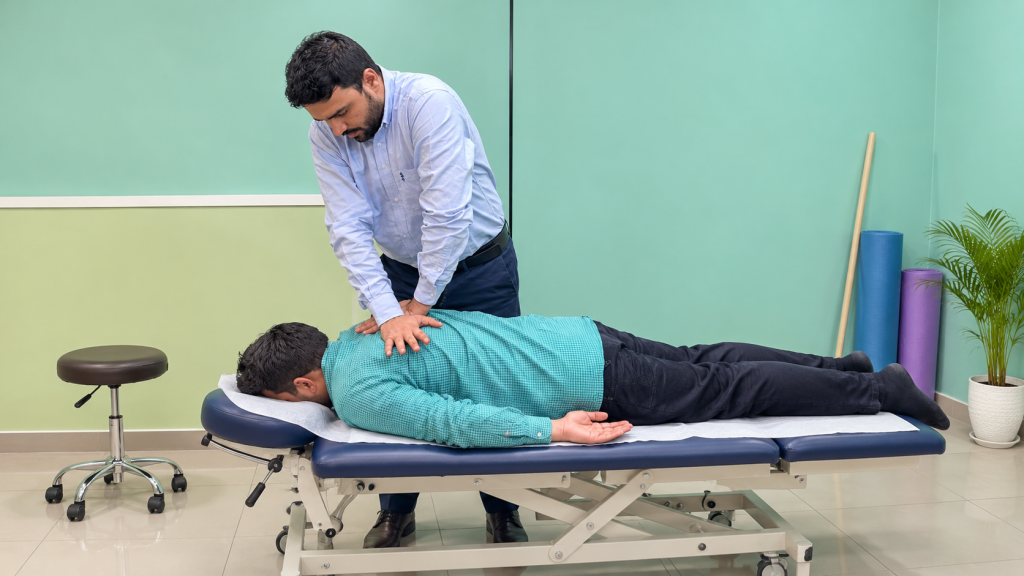
Physiotherapy for back pain starts with an assessment rather than a machine or a technique. The physiotherapist asks how the pain behaves through your day, checks how your back and hips move, and tests strength and sensation in your legs. The aim is to find what is loading the area and what is holding recovery back. Treatment then usually involves:
- Advice on staying active. Current NICE guidance tells clinicians to encourage people with back pain to carry on with normal activities and to support a return to work.
- Exercise. A structured programme built around what you can manage, not a generic sheet of stretches.
- Hands-on work. NICE recommends manual therapy for back pain only as part of a package that includes exercise, never on its own.
- Changes to how you load your back through the day, including how you sit, lift and sleep.
Imaging is not part of the usual pathway, and NICE advises clinicians not to routinely offer scans for back pain outside a specialist setting. Depending on what the assessment finds, your plan may draw on manual therapy, orthopaedic physiotherapy or posture correction.
When Back Pain Needs a Doctor Instead
Most back pain is safe to bring straight to a physiotherapist. Go to an emergency department instead if back or leg pain comes with any of these:
- Difficulty passing urine, or loss of bladder or bowel control
- Loss of feeling around the genitals or back passage
- Numbness or new weakness in both legs or feet
Speak to a doctor first if the pain started suddenly and severely or is getting worse quickly, if you feel hot, cold, shivery or generally unwell, or if you have lost weight without trying. These situations are uncommon, and everything else is ordinary physiotherapy territory.
How Long Back Pain Takes to Settle
Most back pain improves on its own timetable, and knowing that timetable makes the first few weeks less worrying. Around 60% of people recover within six weeks, and 80% to 90% within twelve weeks. Some small aches during recovery are normal and do not mean you have gone backwards.
Two things shift that curve. Staying gently active helps, because long periods of lying down slow recovery down. So does getting assessed early, particularly if the pain has already stalled past two or three weeks or keeps returning.
Home Visit or Clinic Visit for Back Pain
Either works for back pain. The choice usually comes down to how mobile you are and what your treatment needs.
A home visit suits you better if bending into a car or sitting through a commute is painful, if you are recovering from surgery, or if you want the physiotherapist to see the desk, chair and bed your back deals with daily.
A clinic visit suits you better if you need equipment, want space for a structured exercise programme, or are building back towards sport and want progress tested properly.
Many people start at home during the painful phase and move to a clinic as they improve.
Where You Can Get Treated for Back Pain
If travelling is difficult, a physiotherapist can come to your home. If you would rather be seen at a clinic, appointments are available in Gurgaon and Noida, and in Delhi at Paschim Vihar and Dwarka.